

Carlo Acutis – a saint of the digital age
Carlo Acutis was born in London on 3 May 1991. Shortly after his birth, his family moved to Milan in Italy. Even as a child, Carlo developed a deep faith. Although his parents were not particularly religious at first, he was passionate about the Catholic faith and attended Holy Mass every day whenever possible. The Eucharist and adoration were particularly important to him. He once said: “The Eucharist is my motorway to heaven.”
Alongside his faith, Carlo had many interests. He played football, played music, loved animals and was passionate about computers and IT. He used his technical skills to spread the word of the faith. He designed websites and developed a highly acclaimed online exhibition on Eucharistic miracles around the world. Through this, he wanted to show that modern media can be used to lead people to God.
Carlo was helpful and considerate towards others. He stood up for classmates who were excluded, shared his pocket money with those in need, and treated everyone with respect and kindness.
In October 2006, Carlo was suddenly diagnosed with a particularly aggressive form of leukaemia. He accepted his illness with great trust in God and said he wished to offer up his suffering for the Pope and for the Church. He died in Monza on 12 October 2006, aged just 15. In accordance with his own wishes, he was buried in Assisi.
Why was Carlo Acutis canonised?
Carlo was canonised because his life reflected the Christian faith in an extraordinary way. He showed that holiness does not depend on age, but on love for God and one’s neighbour. Particularly exemplary was the way he used his knowledge of modern media to spread the faith and to bring people who had little or no contact with God’s message into contact with it. Pope Francis canonised Carlo Acutis on 27 April 2025.
Why can Carlo Acutis be a role model for us?
Carlo shows that holiness does not mean doing extraordinary things, but doing ordinary things with extraordinary love, total commitment and all the skill one possesses. He combines faith and modern technology, prayer and everyday life, joy and responsibility. He particularly encourages young people to live their faith openly and to use their talents for the common good.
Feast day: 12 October
St. Carlo Acutis, Pray for us!
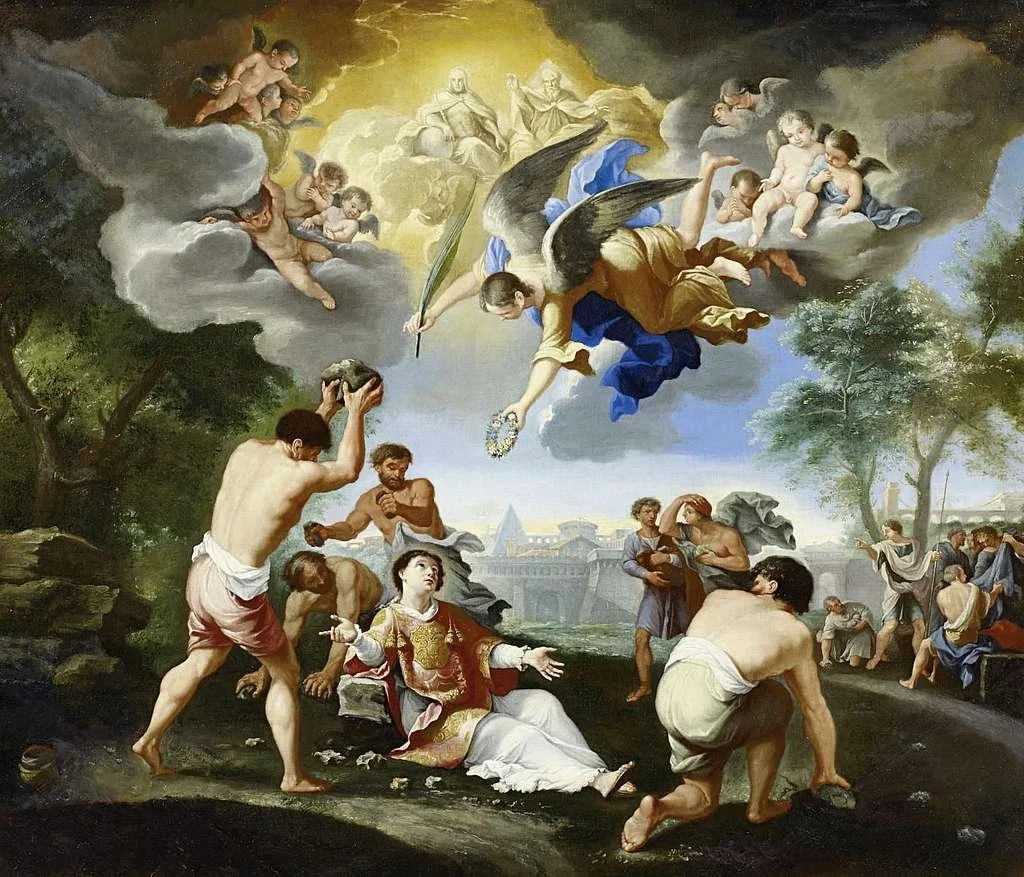
Saint Stephen – the Church’s first martyr
Saint Stephen is regarded as the first Christian martyr, that is, the first person to be killed for his faith in Jesus Christ.
His life
We learn about Stephen’s life primarily from the Acts of the Apostles (chapters 6–7). As the first Christian congregation in Jerusalem continued to grow, the apostles had to concern themselves not only with proclaiming the Gospel, but also with caring for the poor, widows and those in need. The congregation therefore chose seven men to take on this ministry. Stephen was one of them.
The Acts of the Apostles describes him in these words: “But Stephen, full of grace and power, performed wonders and great signs among the people.” (Acts 6:8)
He cared for people in need, boldly proclaimed faith in Jesus Christ and won many people over to the Gospel.
His courage before the Sanhedrin
Stephen came into conflict with the religious leaders of Jerusalem because of his preaching. They accused him of speaking against the law of God and against the Temple.
He was brought before the Sanhedrin. There, Stephen delivered a long speech (Acts 7), in which he traced the history of Israel and made it clear that God had repeatedly sent prophets, who were, however, often rejected. Finally, he openly confessed his faith in Jesus Christ as the promised Messiah.
The Bible records: “I see the heavens opened and the Son of Man standing at the right hand of God.” (Acts 7:56) These words enraged his opponents so much that they led him out of the city and stoned him.
His Death
As Stephen was being stoned, his extraordinary strength of faith was evident. He prayed for his murderers – just as Jesus had done on the cross. His final words were: “Lord Jesus, receive my spirit! Lord, do not hold this sin against them!” (Acts 7:59)
With these words, Stephen died as the Church’s first martyr. A young man named Saul was also present at his stoning; he was supporting the persecution of the Christians (Acts 7:58). This Saul later became the Apostle Paul through his encounter with Christ – a sign that Stephen’s witness continued to have an impact long after his death.
Why was Stephen canonised?
Stephen was not canonised through a specific process. In the early centuries of the Church, martyrs were venerated as saints immediately because they had given their lives out of love for Christ.
What can we learn from Stephen?
Saint Stephen reminds us that Christian faith requires courage. He shows that true strength lies not in violence or power, but in faithfulness to one’s convictions and in love even towards those who wrong us. Stephen can be a role model for soldiers in particular: he embodied responsibility, steadfastness and integrity. His life makes it clear that courage is needed not only on the battlefield, but also when it comes to standing up for truth, justice and the dignity of every human being.
But even before his death, he was exemplary, for he took responsibility for the members of the congregation, organised matters, ensured fair distribution and resolved conflicts. He enjoyed the trust of others. Even under pressure, he remains capable of acting and remains true to his values and convictions.
A professional military person is not defined solely by military skill. Equally important are: professional competence, a sense of responsibility, integrity, steadfastness, respect for the dignity of every human being, and acting in accordance with the law and one’s conscience. Stephen shows that professionalism is always a matter of character. His expertise, his reliability and his ethical conduct form a unified whole.
Feast Day: 26 December
St. Stephen, Pray for us!