
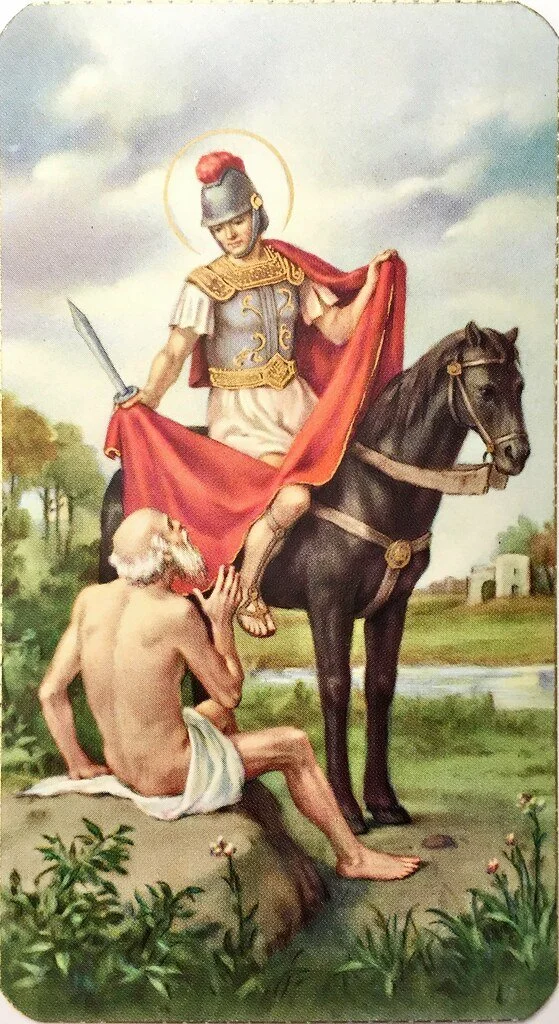
Saint Martin: a man of mercy and generosity
The life of Saint Martin
Martin was born around the year 316 in Savaria (now Szombathely in Hungary).
His father was a Roman officer, and Martin too initially became a soldier in the Roman army. He served as a cavalryman in the Imperial Guard.
Even as a young man, Martin took an interest in the Christian faith. Although his family were not Christian, he was guided onto the Christian path as a teenager.
During his time as a soldier, he learnt that being a Christian means taking responsibility for other people.
Sharing his cloak – the best-known story
The best-known story from Martin’s life took place in Amiens, France.
On a cold winter’s day, Martin came across a poor, almost naked beggar at the city gate. Many people walked past him, but Martin stopped. He himself had nothing but his soldier’s cloak. With his sword, he cut the cloak in two and gave one half to the shivering man.
The following night, Martin had a dream: Christ appeared to him clad in the half-cloak and said, ‘Martin, who has not yet been baptised, has clothed me with this cloak.’
This experience strengthened Martin’s faith. He realised that whatever he does for a person in need, he does for Christ himself.
From Soldier to Bishop
Martin eventually decided against a military career and chose to devote himself entirely to serving Christ. He was baptised and became a monk.
At first, he led a simple life of prayer and seclusion. Later, he founded a monastery in Ligugé near Poitiers, one of the first monasteries in France.
In the year 371, Martin was elected Bishop of Tours against his will. People held him in high regard for his humility and his closeness to the poor. Even as a bishop, he lived a simple life and remained connected to the people.
Martin championed the poor, the sick and prisoners. He proclaimed the faith not only through words, but above all through his life.
He died on 8 November 397 in Candes, near Tours.
Why is Saint Martin venerated?
Saint Martin was not venerated because he was powerful or successful. He became a role model because he made Christ’s love visible in everyday life. Martin shows that true nobility is not a matter of rank or privilege, but of character, humility, and service to others.
The significance of Saint Martin for us today
The story of sharing his cloak is more than just a beautiful legend. It poses an important question to us: Do I notice the people who need help – or do I simply walk past?
Martin reminds us that charity often begins with small gestures: giving someone your time, listening, sharing, helping, standing up for others.
Especially at a time when many people are looking out only for themselves, Martin demonstrates a different attitude: a person does not live only for themselves, but always for others as well.
Saint Martin can be a role model, particularly for those in positions of responsibility.
A soldier carries not only equipment, but also responsibility.
Martin’s story shows that:
• Strength is there to protect – not to belittle others.
• Leadership means keeping people in mind.
• Comradeship means never leaving anyone behind.
Martin was first a soldier and later became a servant of the people. His life therefore combines two important attitudes: a willingness to protect and a willingness to serve.
His message is:
“A person is truly strong when they use their strength for the benefit of others.”
Feast Day
The feast day of Saint Martin is 11 November, the day of his burial.
On this day, Christians around the world remember a man who showed that sharing does not make you poorer – sharing makes the world a more humane place.
St. Martin of Tours, pray for us!
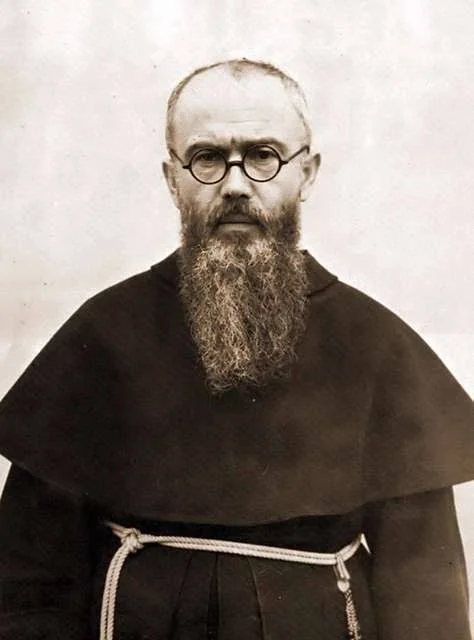
Saint Maximilian Kolbe – a life of selfless love and sacrifice
Childhood and the path to the priesthood
Maximilian Kolbe was born on 8 January 1894 as Rajmund Kolbe in Zduńska Wola, near Łódź in Poland.
Even as a child, he was deeply religious. According to one account, he later recounted that as a boy he had had a special experience: in a vision, the Virgin Mary had offered him two crowns – a white crown for purity and a red crown for martyrdom. He accepted both.
At the age of 13, he entered the Franciscan Minorite seminary and took the religious name Maximilian. He studied philosophy and theology in Kraków and Rome and was ordained a priest in 1918.
His particular passion lay in proclaiming the faith.
Mission and service to others
Maximilian Kolbe was a man of great drive. He wanted the message of the Gospel to reach as many people as possible. At the same time, practical service to others was important to him.
He went to Japan as a missionary and founded a community and a magazine there. In doing so, he demonstrated courage, perseverance and a willingness to engage with a foreign culture. For him, faith did not mean withdrawing from the world, but rather a mission to give hope to others.
In 1931, he founded the Mugenzai no Sono monastery (‘Garden of the Immaculate’) in Nagasaki. It is noteworthy that he chose the site against the advice of many: he had the monastery built on a hillside separated from the city centre by a mountain. When the atomic bomb was dropped on Nagasaki on 9 August 1945, this mountain ridge largely protected the monastery from destruction.
Maximilian Kolbe in the Auschwitz concentration camp
Due to his failing health – Kolbe had been suffering from tuberculosis for years – and because the leadership of his order needed him back in Poland, he returned to Niepokalanów in 1936. There, he once again took charge of the large Franciscan monastery and the Catholic publishing centre.
Following the German invasion of Poland in September 1939, the monastery took in thousands of refugees, including many Jewish families. Kolbe was initially arrested for a short time and then released. On 17 February 1941, he was arrested again by the Gestapo. On 28 May 1941, he was deported to the Auschwitz concentration camp, where he experienced the inhuman cruelty of the Nazi camp system: hunger, forced labour, humiliation and death were part of everyday life. Yet even under these conditions, Father Kolbe tried to help others. He encouraged them, prayed with them and shared what little he himself had.
In July 1941, the act that made him world-famous took place:
After a prisoner had escaped from the camp, the camp commander ordered, as a reprisal, that ten prisoners should be left to die in the starvation bunker. One of the men selected was Franciszek Gajowniczek, a family man. He cried out in despair that he would never see his wife and children again.
Father Kolbe then stepped forward from the ranks of the prisoners and asked to be allowed to die in this man’s place. The SS found this request unusual, but they accepted the exchange. Together with the other nine men, Maximilian Kolbe was locked in the starvation bunker.
Even there, he retained his humanity. He prayed with the other prisoners and accompanied them in their final days. After about two weeks, only Father Kolbe and one other prisoner were still alive.
Finally, on 14 August 1941, Maximilian Kolbe was murdered by a lethal injection.
Why was Maximilian Kolbe canonised?
Father Maximilian Kolbe was canonised by Pope John Paul II on 10 October 1982. The Church honoured him not only for his martyr’s death, but above all for the witness he gave throughout his life.
He was canonised because he embodied the Christian virtues in a special way: love, charity, and self-sacrifice.
The most important act of his life was that he gave up his own life to save another.
What can we learn from Maximilian Kolbe?
The life of Father Maximilian Kolbe poses the question: How do I behave when things get difficult? Will I remain true to my values, even if it brings disadvantages? He shows that true strength lies not only in physical power or assertiveness, but in character, attitude and a willingness to take responsibility.
A good comrade is someone who does not leave others in the lurch. A responsible person does not look only to their own advantage but takes responsibility for others.
Kolbe teaches us that true selflessness means placing the needs of others above our own comfort, interests, and even our own lives.
Day of Remembrance: 14 August
St. Maximilian Kolbe, pray for us!